
"Deadwood" and the community of spirits
On rewatching David Milch's masterpiece in the age of the oligarch
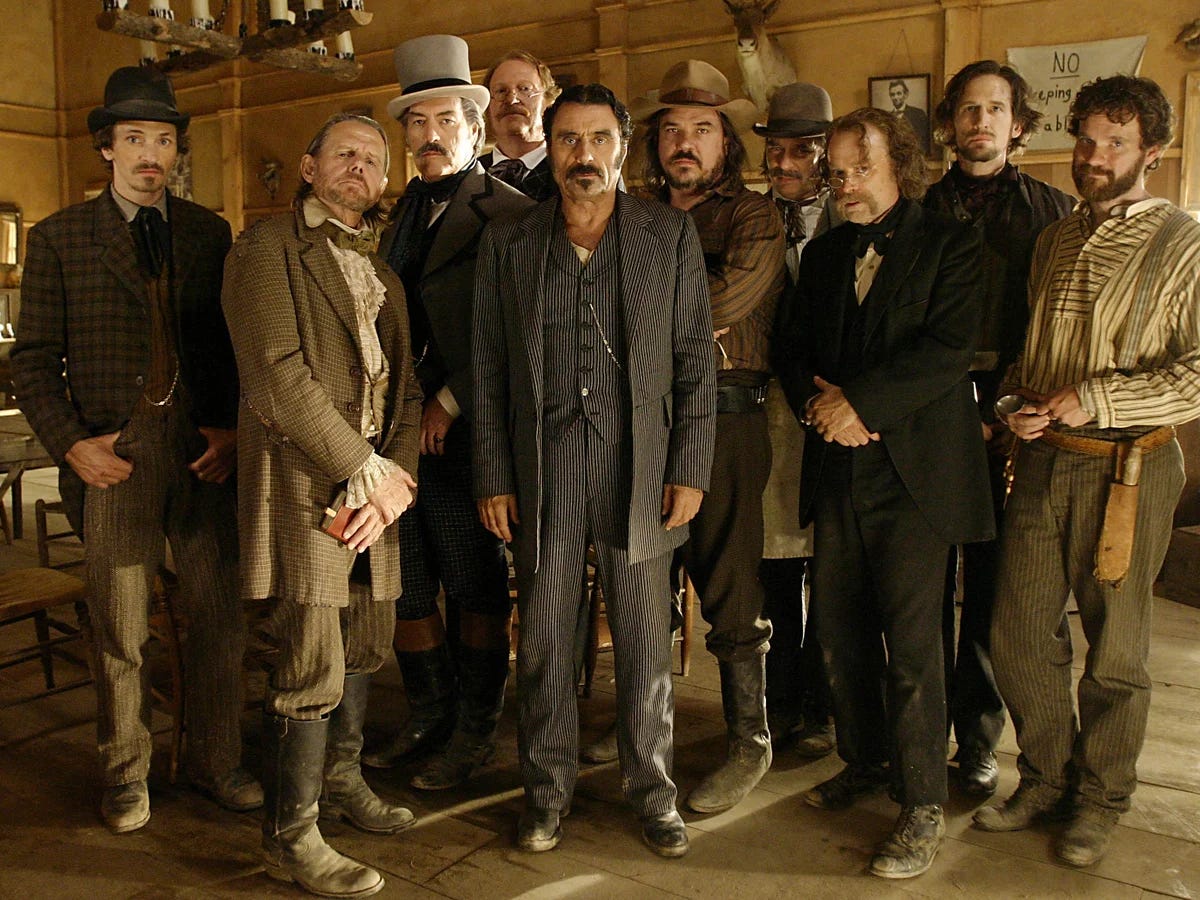
Every few years, when I feel as if the state of the world necessitates “a strong moral principle to prevent me from deliberately stepping into the street, and methodically knocking people’s hats off,” I try to calm myself by rewatching Deadwood, the David Milch-helmed HBO show that ran from 2004 to 2006.
I never regret it. The experience always leaves me with a sense of awe.
How did something so sophisticated, so ambitious, so weird, and so expensive manage to survive the entertainment industrial complex death-march from pre-production to public release? How did it manage to hold on for 3 whole seasons before HBO pulled the plug? Was the demiurge who seems to be in full control of the world today on some kind of sabbatical? Can we send him back?
But during my most recent rewatch of the show, I found myself fixating on something else — something more particular — that the state of the world today doubtless primed me to notice in a way I would not have, say, 10 years ago.
That something was George Hearst (Gerald McRaney) — a fictionalized version of the father of William Randolph Hearst, aka Charles Foster Kane — who is the closest thing the show has to a Big Bad and, in ways I’ll try to explain below, an embodiment of what Milch (via Deadwood) argues are the human forces in this world who drive us, with terrifying certainty and utter remorselessness, towards a future characterized by alienation, domination, and exploitation.
But before I fully turn towards examining Hearst — both as a symbol and as an archetype of the kind of people, with all their self-justifications and pride and self-pity, who are the chief proponents of tyranny — it’s worth explaining in fuller detail what Deadwood is about and why Hearst’s arrival in the camp is both dramatically and thematically necessary.
Deadwood’s triune truth
So what is Deadwood about? First, it’s worth recognizing the deceptive simplicity of this question. Deadwood is an audaciously ambitious project. It is trying to be about what it means to be a human being in the modern world; it is, therefore, in a sense, about everything.
That said, it is reasonable to argue that, from the most elevated vantage, Deadwood, despite its capaciousness, is making a specific argument about human nature and human society. And you must understand that argument to understand why Hearst is so important — and so disturbing.
Now, I do not here claim any special powers of divination. Among its many seemingly impossible feats, Deadwood is at once unusually entertaining and exceptionally didactic. If the show were a politician, we’d call it “on message.”
Moreover, Milch, through interviews and his own writings about the show, has been more than happy to explain — with a kind of intellectual rigor that reminds us that he was a star pupil at Yale and spent time as a professor — what he was trying to say in Deadwood, and why.1
The show is an explanation for why human beings, despite their often selfish and anarchic nature, manage so consistently, and of their own volition, to form together into something we call “society” or “civilization,” something better — something nobler, something more beautiful — than the sum of its parts.
Or, as the late scholar and media critic Paul Cantor put it (emphasis mine):2
[W]hat intrigued Milch about Deadwood is the way a motley group of human beings, pursuing—sometimes viciously—their own self-interest could—in the absence of any legal institutions or established government—nevertheless manage to organize themselves into a community and pursue some form of common good.
In short, Milch’s “big idea” about society is a combination of three ideas that are, by themselves, plenty big already. Those three ideas are as follows:
Society is based on “operating fiction[s]”
Society is an “organism”
This “organism” is how God (or “the body of God,” as Milch has called it) is made manifest in our world
Put these three together, and you have Deadwood’s big idea.
The operating fiction(s)
Let’s start with the first idea — that society relies on multiple and overlapping “operating fictions.” (Each one being, to quote the title of the two-part episode that opens Deadwood’s second season, “a lie agreed upon.”)
In a 2005 interview with Salon, Milch spoke of that greatest operating fiction of them all, the law (emphasis mine):
You know, the cop series I had done [NYPD Blue] tried to engage the theme that in order to administer the law, you have to break the law. That is, that the idea of equality before the law is an operating fiction of democracy. Any cop will tell you. If a cop is forced to watch a cop show, and he hears the suspect given his Miranda warning, he just turns away, because no suspect is ever given his Miranda warning until after the cop has gotten the information he needs. If he’s given his Miranda warning, the cop can’t do his job, because then the cop has to turn him over to a lawyer. What cops are hired to do is to control people who will not abide by the social contract.
Milch takes this idea of the foundation of human coexistence being “operating fictions” a step further, though, and connects it to the foundational “operating fiction” of the Declaration of Independence (emphasis mine):
What we say in our treasured documents is not, “These truths are self-evident, that all men are created equal.” What we say is, “We hold these truths to be self-evident” — in other words, we’re going to act as if these truths are self-evident, but in practice, those truths have never been self-evident. And the reason that cops only trust other cops is because they know that they’ve been hired to lie, they’ve been hired to beat the balls off people, and get them to confess so they can be excluded from society. That’s the first part of their job. The second part of their job is to lie about what they did. And the third part of their job is to know that if they’re caught, they’re going to be put in jail.
But rather than wax philosophical about how Deadwood is really about America (though it quite obviously is), Milch returns to the idea of the law and notes two paradoxes. The first paradox is cops acting lawlessly in the name of upholding the law. The second paradox is violently lawless people nevertheless creating a society based on restricting violence and lawlessness (emphasis mine):
I wanted to push that situation further, to the point where it was acknowledged by everyone that there was no law, and then to try and figure out how we govern ourselves, how we improvise the structures of governance in an environment which acknowledges that it is the abrogation of everything but brute force.
What Milch means by that “abrogation” comment, I’m pretty sure (it’s a little confusing) is: At the beginning of the show, the environment in which the town of Deadwood is built is one in which no law beyond brute force holds any real power.
And this is not just a descriptive thing; it’s not just acknowledging that, in Deadwood — especially during its first season, the camp’s early days — a man can kill another man and, provided the victim didn’t have any creditors upset about losing their investment, likely go about his day without further consequence.
It’s also a factual thing; Deadwood is an illegal settlement on what is, at the time of its founding, land that belongs to the Lakota people, not the United States. Deadwood is, quite literally, operating entirely outside the law. It is not in America; it is, in fact, a flagrant violation of the sovereignty of the people who nominally control the land on which it stands.
And yet, by the time we reach season three, it is on the verge of being annexed to a US territory — governed out of Yankton, even though the state of South Dakota does not yet formally exist — and it has (at least nominally) a mayor and a sheriff and health inspector. As Milch put it, the residents of Deadwood, seeing that outside forces are keen to claim the town — and most especially its gold — as their own, begin to “act governmental.”3
Crucially, they do not do this because they have any fondness (or desire) for government in the abstract. Quite the opposite; most of the people who have come to Deadwood have done so, at least in part, to escape government.
But what Milch suggests in the show (and has said explicitly elsewhere) is that the leaders of Deadwood believe that in order to protect their own interests from Yankton — and, behind it, the US government — it is essential that they cooperate to form some semi-official countervailing institutions of their own.
In other words, if government is a means of taking people’s wealth from them, then, the leaders of Deadwood conclude, the best chances they have of stopping that from happening is to form a (minimal) government of their own to combat that larger government’s purposes.
Here, too, then, we see another “operating fiction.”
According to Milch, government is not formed by “the people” to pursue some high-minded vision of the greater good. Government is something made, ad hoc, by one group of self-interested individuals to protect themselves against another group of self-interested individuals.
That’s the inoperable truth; “of, by, and for the people” is the operating fiction.
It is worth emphasizing, though, that it would be wrong to see this as Milch saying this is all bullshit. As I hope the sections below on the more spiritual aspects of Deadwood will make clear, Milch is what John F. Kennedy called an “idealist without illusions.”He is not a nihilist.
Rather, he is an adult who — like every adult must — holds two contradictory ideas in his head at the same time. The “lies” we “agree upon” are “fictions,” yes; but they’re necessary fictions, and it is through an accretion of these fictions that an anarchic rabble of self-interested individuals is transformed into a community.
Or, as Milch often refers to it, “an organism.”
Society as an “organism”
To understand what Milch means when he refers to society as an “organism,” I want to ask you to indulge me and read a long quote from episode three of Deadwood’s first season.
It’s a funeral oration given by Deadwood’s preacher, Reverend Smith (Ray McKinnon), at the funeral of Wild Bill Hickock (Keith Carradine), a celebrity gunslinger who is depicted in the show as a kind, decent, and profoundly self-loathing depressive with a death-wish that is eventually consummated by an alcoholic gambler.
Hickock and the gambler have been playing poker against one another for days. The tension between them is palpable. (At one point Hickock, who is usually near-stoical in his reserve and performative dignity, tells his adversary, in a rage, that the latter’s mouth reminds him of female genitalia.)
But after a game during which Hickock takes his sparring partner for all he’s got, Wild Bill goes one step too far — he tosses the man a poker chip and urges him to buy himself a meal. The moment speaks well of Hickock’s basic humanity, but one can tell that his foe takes it as a serious affront.
He wants to take Hickock down. He does not want to be reminded, via Hickock’s act of pity, that he is the lesser man.
And so, inevitably and not long thereafter, the man sneaks up behind Hickock and shoots him in the back of the head, killing him instantly. Everything about the scene implies that Hickock is aware of what is coming and simply chooses to let it happen. (Indeed, in an earlier scene, we see Hickock shoot a man he rightly suspects intends to kill him, even before the latter has had the chance to draw his weapon.)
It is difficult, therefore, to interpret Hickock’s demise as anything less than a kind of suicide by proxy. This is certainly the interpretation that those at the camp who knew Hickock best draw, and we can see how it haunts them for the remainder of the series.
Throughout the show, Milch suggests that one of the solvents that turns a collection of individuals into a community is shared trauma. And, in the world of Deadwood, Hickock’s murder is a shocking and tragic event — so much so that this town’s otherwise brutally unsentimental residents form a long, long line to pay their respects to Hickock’s corpse before its burial.
The tragedy elicits, even in Deadwood’s hardest hearts, “pity” — something that, Milch suggests, is no less essentially human than “lower” qualities like selfishness and aggression.
This is the context in which Reverend Smith — a character who immediately differentiates himself from the rest of Deadwood’s population by his capacity for kindness and pity — delivers an oration that, in many ways, also functions as not only Deadwood’s mission-statement but Milch’s philosophy.4
Smith says (emphasis mine):
St. Paul tells us, “By one Spirit are we all baptized into one body, whether we be Jew or Gentile, bond or free, and have all been made to drink into one Spirit. For the body is not one member but many.” He tells us, “The eye cannot say unto the hand, I have no need of thee; nor again the head to the feet, I have no need of thee. Nay, much more those members of the body which seem to be more feeble, and those members of the body which we think of as less honorable, all are necessary.” He says that “there should be no schism in the body, but that the members should have the same care, one to another, and whether one member suffer, all the members suffer with it.” I believe in God’s purpose, not knowing it. I ask Him, moving in me, to allow me to see His will. I ask Him, moving in others, to allow them to see it.
As Kristen Martin wrote for NPR, this is nothing less than a declaration “that solipsism is a lie, that we must remember that we are as humans all interconnected.”
But here, through Reverend Smith-channeling-Saint-Paul, we hear what Milch believes is true. We are “not one … but many.” None of us has a right to say, “I have no need of thee” to another, because “all are necessary.”
In the Salon interview I quoted above, Milch had this to say about Smith’s remarks (emphasis mine):
In other words, because we misunderstand our natures, does that exclude us from the community of spirits? And the answer is no, it just means we misunderstand our natures. So many of these characters misunderstand their natures, but that does not prevent us from recognizing that they’re of the body of Christ. My feeling about “Deadwood” is it’s a single organism, and I think human society is the body of God...
Our belief that we are separate from each other — that we are distinct, atomized individuals; that we are not part of some larger “body” — is the “solipsism,” as Martin puts it, that causes us to “misunderstand our own natures.”
But even though we are all afflicted with this pernicious misunderstanding, Milch does not believe we are doomed to remain in perpetual ignorance. We are capable, he believes, of recognizing — even just dimly — that we are part of a community, part of the “body.” He explains (emphasis mine):
If you go to any small town, you’ll see in the center of town signs that advertise the weekly meeting of the Lion’s Club and the Optimists and the Kiwanis. You know, a bowling team, a bridge club? All of those things express our impulse to recognize that our most confident and satisfied sense of our individuality is found in relating to something outside of us.
Here, then, is another paradox: In order to most fully and confidently embody “our own individuality,” we must “relat[e] to something outside of us.”
And within the world of Deadwood, populated though it is by self-seeking murderers and pimps and alcoholic gold-diggers, no one misunderstands themselves more profoundly — and more destructively — than George Hearst.
Enter Hearst
In Deadwood, George Hearst, a mining tycoon who would go on to become a U.S. Senator, is the rejection and negation of every aspect of Milch’s philosophy.
He considers himself to be the prophet of a higher truth and has no time for society’s “operating fictions.” He does not recognize himself as part of a larger organism; he is an open misanthrope who insists he’s only happy when he’s with the earth and she is “telling me where to dig into her.”5
When he observes Deadwood, the town, its people, their tangled lives, he does not see the “body of God.” Speaking to a Pinkerton he has enlisted to help him bring Deadwood under his heel — or destroy it, if it refuses — he sneers, with wolfish contempt: “The camp is galvanized. People scurry about. They’ve tasks to perform. They feel important.”
It’s hard to imagine Hearst believes in God; but if he does, his God is “progress.” His version of progress is not of the humanistic kind, however. It’s the progress of the brutal industrialist, the ruthless hyper-capitalist, the imperious tech baron — progress as a boot stamping on a human face, forever.
How Hearst willfully misunderstands his nature
Unlike some of the most sympathetic characters in Deadwood, Hearst isn’t entirely ignorant of his nature. For example, in an exchange with his deputy, Francis Wolcott (Garret Dillahunt), with whom he is “severing” his connection on account of the latter’s compulsive need to murder sex workers, we see Hearst’s signature combination of self-awareness and willful self-ignorance:
Wolcott: As when the earth talks to you particularly, you never ask its reasons.
Hearst: I don’t need to know why I’m lucky!
Wolcott: What if the earth talks to us to get us to arrange its amusements?
Hearst: That sounds like goddamned nonsense to me.
Wolcott: Suppose, to you, it whispers, “You are king over me. I exist to flesh your will.”
Hearst: Nonsense.
Wolcott: And to me... “There is no sin.”
And then, as they part:
Hearst: Does some spirit overtake you? Is that what you mean by the “talk”?
Wolcott: No.
Hearst: It tells me where the color [gold] is. That’s all it tells me.
Despite his egoism, Hearst even shows hints of self-loathing.
In the scene with the Pinkerton I mentioned earlier, Hearst, after mocking Deadwood’s residents for “feel[ing] important,” pauses. Then, as if he is disgusted by his own disgust, he adds, “I oughtn’t to work in these places. I was not born to crush my own kind.” In a similar moment later in the series, he growls to another underling: “My proper traffic is with the earth. In my dealings with people, I ought solely have to do with [—s] and whites who obey me like dogs.”
And yet, in another scene, he cries tears of self-pity over, in so many words, his position as an outsider — as separate from the “body” of the camp (and, more generally, it seems, the “body” of human society itself):
I hate these places … because the truth that I know, the promise that I bring, the necessities I’m prepared to accept, make me outcast. Isn’t that foolish? Isn’t that foolishness? An old man, disabused long ago of certain yearnings and hopes as to how he would be held by his fellows; and yet I weep.
Then, having composed himself, he once again adopts his self-appointed role as a prophet — if not God Himself — and vows to “take [Deadwood] down like Gomorrah.”
Hearst as “the best in us, as well as the worst”
Due to a combination of Milch’s writing and Gerald McRaney’s performance, however, we recognize something human in Hearst. His will-to-power, his impatience, his disdain for the irrationalities and hypocrisies — the operating fictions — that stand in the way of the “truths” he believes he understands and represents; these are all, in at least some ways, relatable character traits.
He is unquestionably Deadwood’s villain; but there is also something correct, if not quite “right,” about George Hearst. His desire to impose order on this motley rabble is not attractive. But it is understandable.
For example, the kind of “progress” on whose behalf he claims to speak — “amalgamation and capital” as Charlie Utter (Dayton Callie) calls it, only half-comprehendingly — is indeed coming. We know that, of course; but most of the characters in Deadwood also take it for granted, regardless of whether they welcome it.
And, most interestingly, especially from today’s vantage, Hearst’s indifference to the on-the-ground messy realities of human civilization — his preference for what Cantor describes in his essay as “abstraction” — leads him to be, by the extremely low standards prevalent within the camp, one of the show’s least-racist characters.
To be clear, this is not because he is a humanist. As Cantor explains, it is, ironically, because Hearst so insistently places himself apart from and above the rest of society that he is — again, relatively speaking — indifferent to white supremacy, one of the most noxious “operating fictions” of the time.
This is made explicit during a scene in which Hearst converses with his Odell Marchbanks (Omar Gooding), the son of his cook, both of whom are Black, about the latter’s claim that he has found gold in Liberia and would like to sell the rights to Hearst.
First, that Hearst is having a sit-down meal — in public, no less — with a Black man is, in the Deadwood of the time, a transgressive act. There are precious few Black people in Deadwood, and those that we do see live under the constant threat of being lynched. We are still decades away from Jim Crow being fully institutionalized; but the direction of things is clear. This is not a time of racial progress.
Still, because Hearst cares much more about gold than he cares about the “small-mindedness and self-interested behavior that’s so pervasive in this shithole,” he has dinner with Odell. At one point during their conversation — which is much more like a duel, given Odell’s falsity and Hearst’s narcissistic paranoia — Odell stands up, offended by Hearst’s suggestion that he (Odell) may be trying to fleece him.
Hearst is impressed, in a patronizing way, by Odell’s pride, and urges him to calm himself and sit back down. He then explains why, to him, gold is the only “color” that matters (emphasis mine):
Hearst: But for that gold, you’d never have sat at my table. And for the effrontery in your rising-up, except that you’d showed me the gold, I’d’ve shot, or seen you hanged, without a second thought. The value I gave the gold restrained me, you see, your utility in connection with it … Gold confers power, and that power is transferable. Power comes to any man who has the color.
Odell: Even if he is black.
Hearst. That is our species’ hope—that, uniformly agreeing on its value, we organize to seek the color.
In Deadwood: Stories of the Black Hills, Milch writes about this with characteristic directness (emphasis mine):
Yet the process of abstraction that Hearst embodies, which is symbolized in gold, is also at the very heart of what makes us human. It’s the best in us, as well as the worst, and it is often both at the same time … Hearst sees the power of gold … in the way [it] can eliminate the stickier aspects of our human particularity. That’s why Hearst can befriend Odell, the son of his black chef, Aunt Lou. Odell has discovered gold in Liberia. For Hearst, the agreed-upon value of gold is the root of all civilized behavior. It mandates a calculus of utility that trumps even the most deep-seated prejudice.
As noxious as he is, I will confess that, here in 2026, I wouldn’t mind if more of our world-destroying oligarchs were similarly uninterested in the kind of racist determinism that Hearst regards as contemptibly “small-minded.”
Hearst, Deadwood, and the “community of spirits”
At this point, I hope, I’ve persuaded you that Hearst is the antithesis of the first two of Milch’s three big ideas. He refuses to accept the necessity of “operating fictions,” and he refuses to recognize that human society is “an organism,” rather than a thing onto which he can impose — through a combination of his wealth, his willpower, and “the truth” he “know[s]” — a kind of top-down direction.
To close, then, I’d like to turn to the final of Milch’s three big ideas: that the organism of society represents the “body of God.”
What I want to suggest here is that as we witness Deadwood’s people organize in opposition to Hearst, we see how that “organism” — somewhat despite itself, and with only a vague awareness of its own purposes — responds to threats by making manifest those higher ideals and aspirations we associate with Godliness.
There is a key moment in Deadwood that illustrates this dynamic — and represents a realization of Milch’s argument that although we “misunderstand our natures,” that doesn’t “exclude us from the community of spirits.”
A law beyond law
First, some context: At this point in the narrative, Hearst, frustrated and humiliated by his inability to bend the town to his will, is engaging in wild escalations that seem driven more by his sense of lèse-majesté, and his need to feel dominant, than any pragmatic logic.
He is bringing in Pinkertons by the dozens — these are the agents through which he hopes to turn Deadwood into another “Gomorrah” — while also openly flaunting the authority of the town’s nascent system of law and order by having multiple Cornish laborers who work at his mines murdered for attempting to form a union.
The town’s de facto leader, Al Swearengen (Ian McShane) can see no recourse other than to call in “guns” of his own and launch a preemptive strike against the Pinkertons and even Hearst himself. Yet Swearengen also believes that this will be, at most, a pyrrhic victory; the conflagration will likely destroy the town, and Hearst, being the representative of corporate interests, will simply be replaced by his shareholders with some other titan of industry. Swearengen has no intention of being Hearst’s slave; but even if for no other reason than self-interest, he also does not want to destroy the town he has worked so hard to build.
Out of desperation, Swearengen convenes Deadwood’s leading figures, such as they are, and shares his thinking. He nearly begs, however, for anyone with ideas for a less apocalyptic resolution to share them. None are forthcoming. But then, Deadwood’s Sheriff, Seth Bullock (Timothy Olyphant), shares with the group a letter he has written for the family of one of the Cornish laborers Hearst has had killed.
He hands the letter to A.W. Merrick (Jeffrey Jones), who runs Deadwood’s lone newspaper; and he does this wordlessly, almost as if he himself does not understand what he is doing or why. The letter, which ostensibly has nothing to do with the immediate question Swearengen is trying to answer, is read aloud by Merrick, and is as follows (emphasis mine):
It becomes my painful duty to inform you that Pasco Carwen was killed earlier this week. His body was found in the road. It was not mutilated in any way. His death seems to have been instantaneous as he was stabbed through the heart. Pasco’s funeral occurred today and was attended by coworkers and friends who all shared the same high opinion of him. Everything was done by kind hands that was possible under the circumstances, and a Christian burial was given him. I was not personally acquainted with Mr. Carwen, save for one encounter where he demonstrated grief and deep compassion at the passing of a friend. I knew him by reputation as an earnest worker and a diligent believer in right and wrong. His memory I am sure will always be with those who knew and loved him, among whose number I imagine you as first. A letter from you which I found in his tent causes me to convey this sad intelligence to you. Sincerely yours, Seth Bullock.
It is a remarkable piece of writing (and, according to Reddit, quite similar to a letter the real-life Seth Bullock wrote) and everyone at the meeting is clearly affected by it. Yet Bullock’s purpose remains unclear. Merrick asks him, “What shall I do with this, Mr. Bullock?” In response, Swearengen says, “What’s your fucking paper for? You fucking publish as witness, for Hearst and others to read.”
And thus ends the meeting. Instead of agreeing to organize a preemptive strike that would amount to a kind of murder-suicide, the leaders of Deadwood decide to publish a letter about the murder of an immigrant worker that none of them knew, nor especially cared to know. It clearly feels right to them — or at least most of them — and yet it would be wrong to say that any of them are entirely clear on why that is or what they think its publication will do.
But this is an essential, pivotal moment. This is when, to go back to one of Milch’s earlier quotes, we see how a collection of individuals who “misunderstand [their] nature” can nevertheless, when embodied in the “organism” of society, find themselves in communion with a “community of spirits.”
Or as Reverend Smith put it, channeling Paul during his eulogy for Hickock, they recognize that “all are necessary” — even the immigrant — and therefore can experience “Him, moving in me, to allow me to see His will” and “ask Him, moving in others, to allow them to see it.”
Later in the episode, when recounting the meeting to his friend, the theater troupe leader Jack Langrishe (Brian Cox), Swearengen reveals that, in retrospect, he is “mystified” by his own behavior. He went into the meeting expecting to be told to organize his forces for an orgy of violence; he left it having commissioned the publication of a letter that, he confesses, “Never once mention[s] Hearst,” and certainly doesn’t call him to account for his crimes against both the law and Deadwood’s social contract.
Whether out of friendship, sycophancy, or true wisdom, however — and I think Milch would say the reason is not so important as the result; because, again, we so often “misunderstand” our own nature — Langrishe argues that Swearengen should not be mystified.
The decision to publish the letter, he says, makes perfect sense (emphasis mine):
Mystified, Al, at proclaiming a law beyond law to a man who’s beyond law himself? It’s publication invoking a decency whose scrutiny applies to him as to all his fellows. I call that strategy cunningly sophisticated, befitting and becoming the man who sits before me.
Similarly, when Swearengen’s two most loyal henchmen are discussing what transpired during the meeting, clearly trying to understand it themselves, one of them, Swearengen’s chief deputy, Dan Dority (W. Earl Brown), says, with halting but increasing confidence (emphasis mine):
[T]he letter’s contents is witness that... Bullock wrote a nice fucking letter. And it proves... that that’s the sort we are here, the caring sort that would write a letter of that ilk. Furthermore, we don’t give a fuck who knows it, George fucking Hearst included.
While it is hard to draw a direct line from its publication to the series’ resolution, it’s clear that the letter’s publication does indeed have an effect. When Hearst confronts Merrick about its publication, it is obvious that this reminder of, as Langrishe puts it, “a law beyond law,” both shames and offends him (emphasis mine):
Hearst: Thanks, too, for publishing Sheriff Bullock’s letter of condolence to the family of that murdered worker of mine.
Merrick: Oh, you’re welcome.
Hearst: I suppose I should have written them myself.
Merrick: I’d not presumed to suppose in that regard, Mr. Hearst, one way or another.
Hearst: Was the Sheriff’s making his letter part of the public record meant to embarrass or reproach me?
Under Hearst’s orders, a Pinkerton will later savagely beat Merrick for this affront.
Why Hearst is necessary
Ultimately, and to return to the point I made at the beginning of this essay, this is why Hearst is necessary.
It is not until the “organism” of Deadwood is faced by its antithesis that it is able, however fitfully and ignorantly, to connect with that “community of spirits” that helps a group of self-interested individuals, who “misunderstand their nature,” reveal themselves more fully as members of “the body of God,” capable of evoking the “law beyond law” that allows us to recognize that, as Paul says, “there should be no schism in the body … and whether one member suffer, all the members suffer with it.”
To recognize that “all are necessary” — even, in his way, someone like George Hearst.
In that way, he is kind of an anti-David Lynch; and to compare/contrast Milch’s willingness to explain his art with that other towering auteur of the Golden Age of Television — David Chase, who, bless him, still refuses to give a straightforward answer about what even happens at the end of The Sopranos — is to be reminded that genius, too, contains multitudes.
I cannot recommend more strongly that you read Cantor’s essay on Deadwood. To be frank, I originally envisioned the piece you’re reading now differently; but once I read Cantor’s piece, I realized that he had not only already made many of the points I wanted to make but done so better than I could have. I adjusted my approach; but if you find what I’ve written here engaging, I urge you to read Cantor’s analysis too.
This quote is from the Cantor piece.
It’s worth knowing that, originally, Milch wanted to make a show about Ancient Rome — specifically about Rome during the time when Paul was arrested. But HBO was already working on Rome (an underrated show by the incomparable John Milius); so Milch pivoted to a deconstruction and exploration of the Wild West mythos instead.
In one episode, speaking of Seth Bullock (Timothy Olyphant) and Alma Ellsworth (Molly Parker), Hearst confesses that “just this afternoon … displeasure brought me near to murdering the Sheriff and raping Mrs. Ellsworth.”